

From October 2025 through September 2026, low-carbon sources supplied about 43% of Ireland’s electricity consumption, ahead of fossil fuels at roughly 39%. Wind was the largest clean source, providing about a third of electricity, followed by solar at 4%, hydropower at 3% and biofuels at 2%. Gas supplied almost 38%, accounting for nearly all fossil electricity. Net imports covered the remaining 18%; their low-carbon and fossil composition is not specified in these figures. Ireland therefore has a strong clean electricity foundation, but substantial gas use leaves considerable scope to reduce climate emissions and air pollution.
Is Electricity Growing in Ireland?
Electricity consumption per person is growing beyond its previous peak, although only modestly. The latest 2026 figure is about 6,940 kWh per person, exceeding the 2006 record of roughly 6,850 kWh by 89 kWh, or about 1%. More encouragingly, low-carbon electricity generation reached around 3,010 kWh per person, beating the 2025 record by 212 kWh, nearly 8%. Clean electricity is thus setting new records faster than overall consumption per person. These figures demonstrate per-person growth, though population data would also be needed to quantify growth in total national electricity consumption.
Suggestions
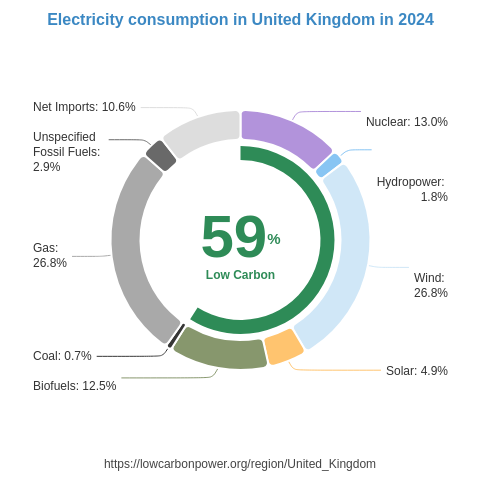
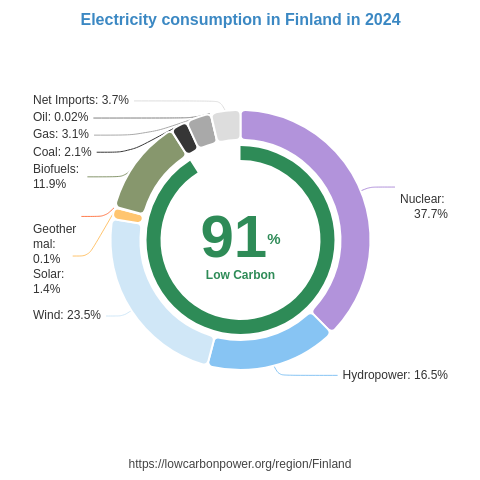
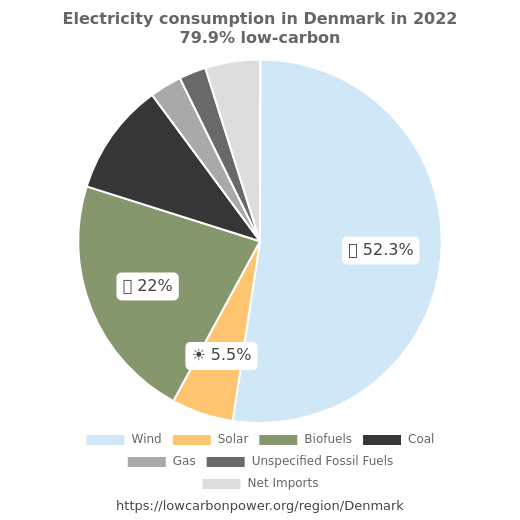
Ireland should build on its substantial wind generation while expanding solar and considering nuclear electricity. Denmark, another northern European country with strong wind resources, generates 58% of its electricity from wind, showing the potential to move well beyond Ireland’s current third. For solar, the Netherlands and Germany offer particularly relevant examples: despite their northern European locations, solar supplies around 20% and 21% of their electricity respectively, compared with Ireland’s 4%. Nuclear could provide an additional source of dependable low-carbon electricity: France generates about two-thirds of its electricity from nuclear, while Finland generates more than a third. Learning from these regions, alongside expanding grids, storage and interconnections, would help Ireland increase clean electricity supply for electrification and growing demand, including from AI.
History
Ireland’s recent low-carbon electricity history has been dominated by wind expansion. In the second half of the 2000s, wind generation rose by 0.5 TWh in each of four listed years, while hydropower fell by 0.5 TWh in 2010. The 2010s brought substantial wind gains, including 1.6 TWh in 2011 and annual increases of roughly 1.2–1.4 TWh in 2015, 2017 and 2018, interrupted by a disappointing 0.4 TWh decline in 2016. Wind then increased by 2.1 TWh in 2020, fell sharply by 1.8 TWh in 2021 and recovered by 1.4 TWh in 2022. Biofuel generation declined by 0.5 TWh in 2023 before recovering by 0.4 TWh in 2024. The latest figures are encouraging: in 2026, wind added 0.6 TWh and solar added 0.5 TWh, broadening Ireland’s clean electricity growth.
Electricity Imports and Exports
Balance of Trade
Nearby Regions