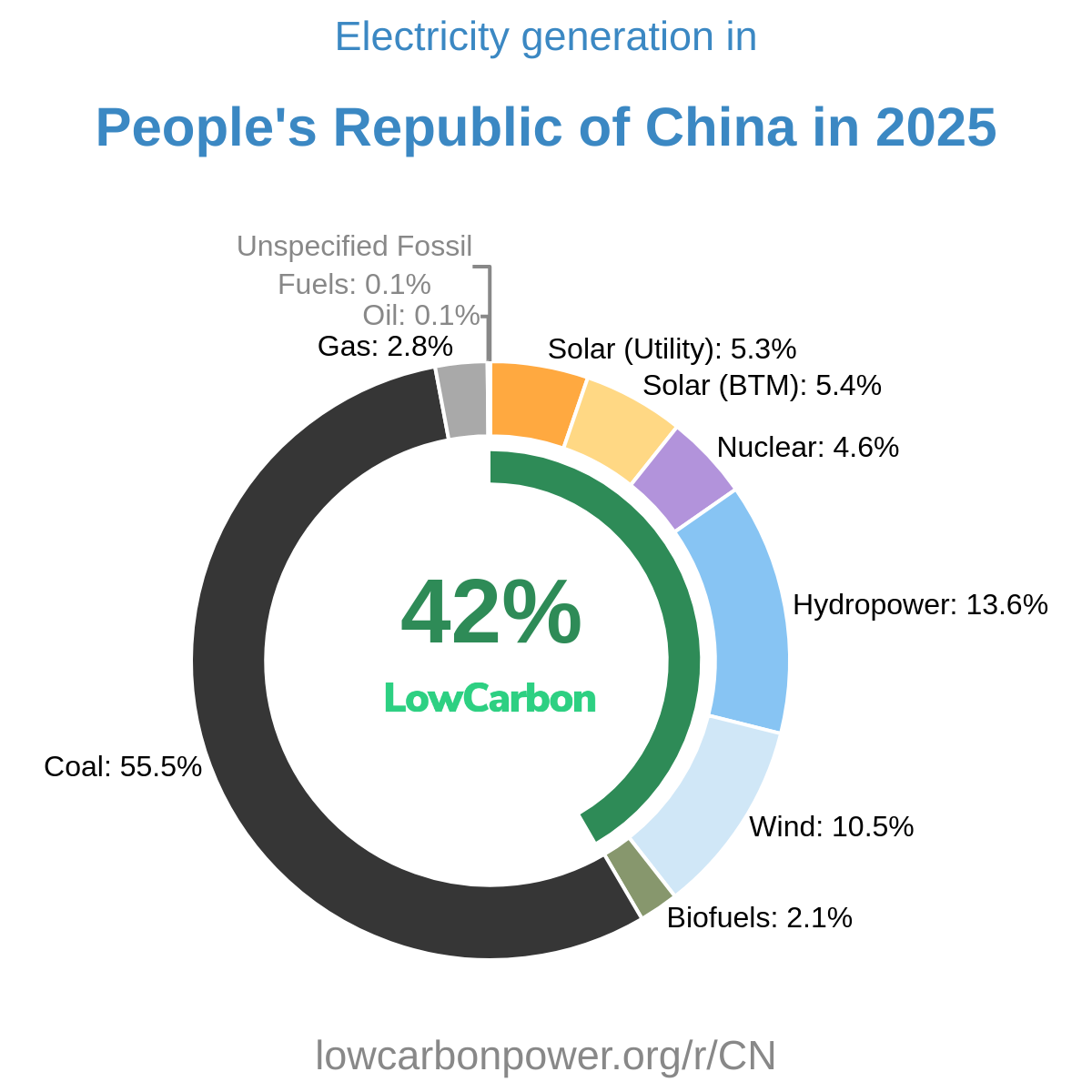


From July 2025 through June 2026, more than half of electricity consumed in the People’s Republic of China came from fossil fuels: about 57%, including roughly 54% from coal and 3% from gas. Low-carbon sources supplied the remaining 43%. Hydropower contributed about 14%, solar almost 12%, wind nearly 11%, nuclear around 4%, and biofuels about 2%. Solar generation was split almost equally between utility-scale installations and behind-the-meter systems, each supplying around 6% of electricity. China therefore has a substantial clean electricity base, but coal still dominates its electricity mix, making further low-carbon expansion important for reducing climate-changing emissions and air pollution.
Is Electricity Growing in People's Republic of China?
Electricity consumption is growing, with the latest 2026 figure reaching a record of about 7,574 kWh per person—173 kWh, or roughly 2%, above the previous record set in 2025. Low-carbon electricity generation also reached a new high of about 3,252 kWh per person, up 115 kWh, or nearly 4%, from its 2025 record. These are encouraging gains, particularly because clean electricity generation per person grew faster than overall electricity consumption per person. Sustaining and accelerating that growth will help meet rising electricity demand from electrification and AI.
Suggestions
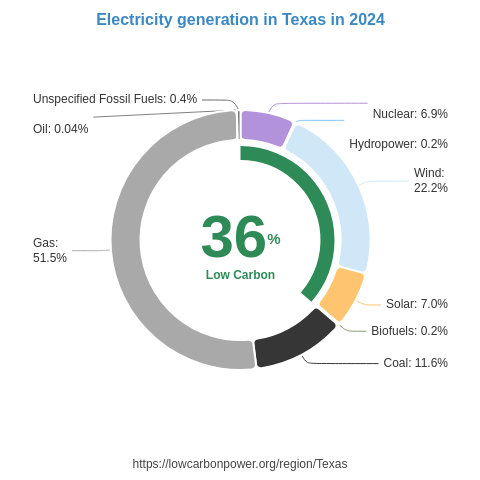
China can build on its already substantial wind and solar generation while expanding nuclear electricity alongside them. Relevant examples include South Korea, a major industrial economy where nuclear supplies 25% of electricity, and France, where its share reaches 67%; both illustrate the scope for nuclear to make a much larger contribution to China’s clean electricity supply. For wind, Germany generates about 31% of its electricity from this source, while the US state of Texas generates 22%, offering useful reference points for large industrial electricity systems. Solar supplies about 31% of electricity in the US state of California and 35% in the US state of Nevada, demonstrating its potential well beyond China’s current share. Continued investment in these technologies, supported by stronger transmission networks and storage, can help China deliver more low-carbon electricity.
History
China’s low-carbon electricity history shows successive waves of substantial growth. Hydropower led the listed gains in the 2000s and early-to-mid 2010s, adding about 70 TWh in 2004, 100 TWh in 2008, and 107 TWh in 2010, followed by particularly large increases of 173 TWh in 2012 and 144 TWh in 2014. Further hydro gains of roughly 60–66 TWh followed in 2015 and 2016. Wind then added about 58–71 TWh annually in the listed years 2017, 2018, and 2020, before surging by 188 TWh in 2021 and continuing with annual increases exceeding 100 TWh through 2025. Solar gains also accelerated, from 66 TWh in 2021 to 99 TWh in 2022 and 155 TWh in 2023. Hydropower’s disappointing 71 TWh decline in 2023 was followed by a strong 206 TWh rebound in 2024. Together, these developments highlight China’s impressive capacity to expand clean electricity generation and the importance of maintaining that momentum.
Electricity Imports and Exports
Balance of Trade
Nearby Regions

.png)